
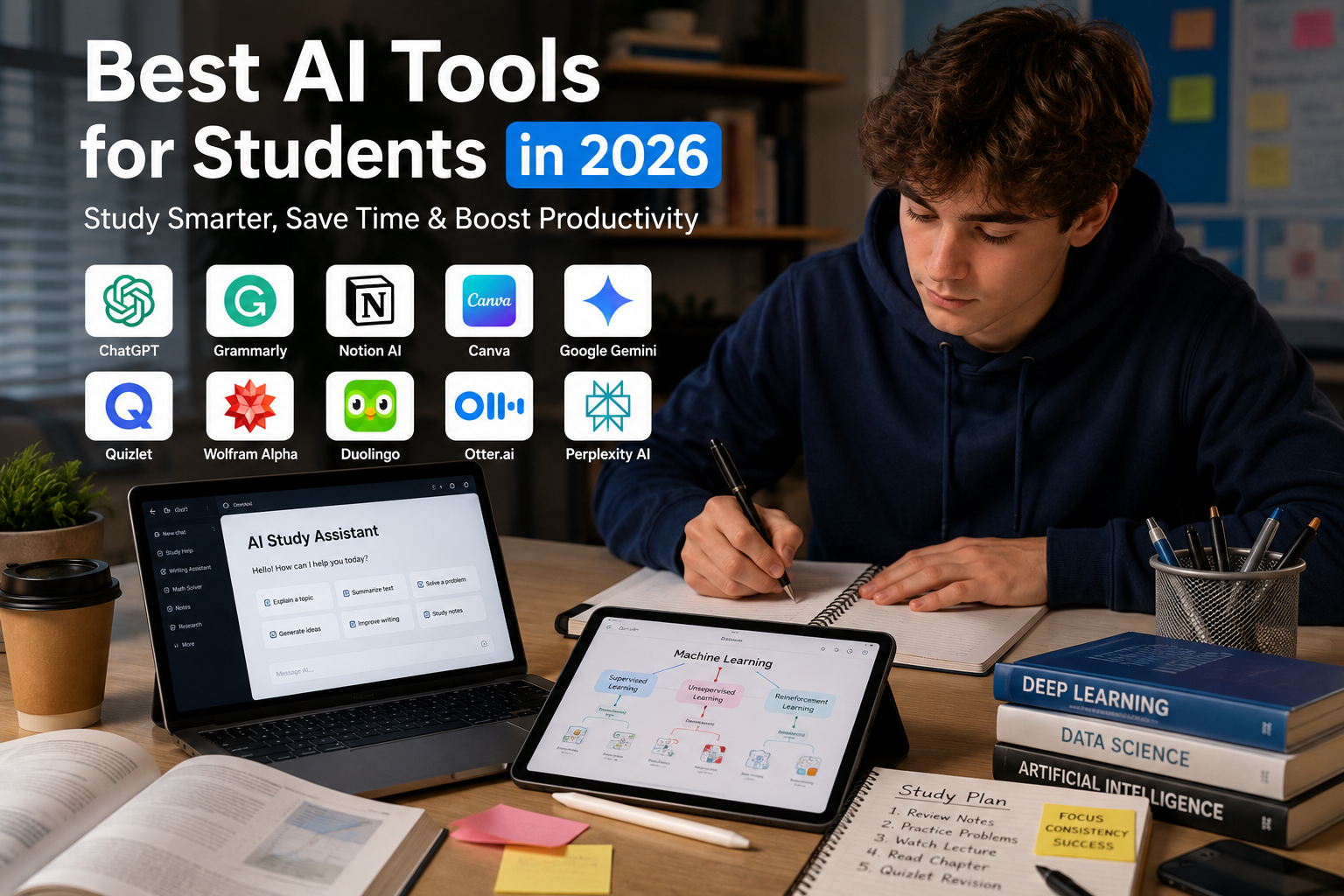
Artificial Intelligence is transforming education faster than ever before.
In 2026, students are no longer using technology only for searching information or watching online classes. AI tools are now helping students:
- Study smarter
- Save time
- Improve writing
- Solve problems faster
- Organize notes
- Learn new skills
- Boost productivity
From school students to university learners, AI-powered tools are becoming an essential part of modern education.
But with hundreds of AI apps available online, one big question remains:
Which AI tools are actually useful for students in 2026?
In this complete guide, you’ll discover the best AI tools for students in 2026, including:
- AI writing assistants
- Research tools
- Study apps
- Productivity platforms
- Math-solving tools
- Language-learning AI
- Note-taking software
- Presentation tools
This article also covers:
- Real-life examples
- Benefits and limitations
- How students can use AI responsibly
- Tips for improving learning with AI
- Frequently asked questions
Whether you are a high school student, college learner, online course student, or competitive exam aspirant, this guide will help you choose the right AI tools to improve your academic life.
Why AI Tools Are Becoming Essential for Students
Modern education is becoming more competitive and fast-paced.
Students today manage:
- Assignments
- Online classes
- Research projects
- Exams
- Presentations
- Skill development
- Internships
At the same time, digital distractions continue to increase.
AI tools help students by:
- Saving time
- Automating repetitive tasks
- Improving learning efficiency
- Organizing study materials
- Supporting creativity and productivity
According to World Economic Forum, AI is expected to significantly influence the future of education and workforce skills globally.
What Makes a Good AI Tool for Students?
The best AI tools are not just “smart.”
They should also be:
- Easy to use
- Time-saving
- Accurate
- Affordable
- Productivity-focused
- Educationally helpful
A good AI tool should support learning — not replace genuine understanding.
1. ChatGPT – Best AI Study Assistant Overall
One of the most popular AI tools in the world, ChatGPT helps students with:
- Research
- Writing
- Brainstorming
- Summaries
- Coding
- Language learning
- Study explanations
Why Students Use It
Students commonly use it to:
- Understand difficult concepts
- Generate study notes
- Improve essays
- Practice interview questions
- Learn programming
Real Example
A university student preparing for exams can ask ChatGPT to:
- Simplify complex topics
- Create revision notes
- Generate quiz questions
- Explain difficult theories
Benefits
✅ Saves time
✅ Beginner-friendly
✅ Multi-subject support
✅ Improves productivity
Important Reminder
Students should use AI as a learning assistant, not for cheating or copying assignments directly.
2. Grammarly – Best AI Writing Assistant
Writing skills are important for:
- Essays
- Emails
- Research papers
- Assignments
- Applications
Grammarly helps students improve:
- Grammar
- Clarity
- Tone
- Sentence structure
Why Students Love Grammarly
It helps make writing:
- More professional
- Error-free
- Easy to read
Real Example
A student writing a scholarship essay can use Grammarly to improve sentence clarity and remove grammatical mistakes.
3. Notion AI – Best AI Productivity Tool
Notion AI combines:
- Note-taking
- Productivity
- AI writing
- Task organization
into one platform.
Best Features
Students use it for:
- Organizing study schedules
- Managing assignments
- Creating summaries
- Planning projects
Why It’s Powerful
It reduces study chaos and improves organization.
4. Canva – Best AI Design Tool for Students
Presentations and visual projects are now part of modern education.
Canva helps students create:
- Presentations
- Posters
- Infographics
- Resume designs
- Social media projects
AI Features in Canva
Canva now includes AI tools for:
- Image generation
- Presentation creation
- Background removal
- Content suggestions
Real Example
A student preparing a classroom presentation can create professional slides within minutes.
5. Google Gemini – Best AI Tool for Research and Search
Google Gemini is widely used for:
- Research support
- Information summaries
- Brainstorming
- Content generation
Why Students Use It
It integrates with:
- Google Docs
- Gmail
- Google Workspace
making it useful for academic work.
6. Quizlet – Best AI Flashcard Tool
Memorization is important for exams.
Quizlet helps students learn using:
- Flashcards
- Practice tests
- AI-generated quizzes
- Study games
Best For
- Language learning
- Medical students
- Competitive exams
- Revision practice
7. Wolfram Alpha – Best AI Tool for Math and Science
Math and science students often need detailed explanations.
Wolfram Alpha helps solve:
- Equations
- Calculus
- Physics problems
- Statistics
- Engineering calculations
Why It’s Useful
Unlike basic calculators, it explains step-by-step solutions.
8. Duolingo – Best AI Language Learning Tool
Language learning is becoming increasingly important in a global world.
Duolingo uses AI-powered learning systems for:
- Vocabulary practice
- Pronunciation
- Grammar learning
Best Features
- Gamified learning
- Daily practice streaks
- Interactive lessons
9. Otter.ai – Best AI Note-Taking Tool
Taking notes during lectures can be difficult.
Otter.ai converts spoken lectures into written notes automatically.
Best For
- Online classes
- Interviews
- Lecture recordings
- Group discussions
Real Example
A student attending online lectures can review automatically generated notes later for revision.
10. Perplexity AI – Best AI Research Assistant
Research is one of the most time-consuming tasks for students.
Perplexity AI helps students:
- Find quick answers
- Explore topics
- Access summarized research information
Why Students Like It
It often provides source-based answers and faster research summaries.
Best AI Tools by Student Needs
| Need | Best AI Tool |
|---|---|
| Writing | Grammarly |
| Research | ChatGPT / Perplexity |
| Productivity | Notion AI |
| Math Help | Wolfram Alpha |
| Presentations | Canva |
| Language Learning | Duolingo |
| Note Taking | Otter.ai |
| Study Revision | Quizlet |
Benefits of AI Tools for Students
1. Saves Time
AI helps automate repetitive tasks.
2. Improves Productivity
Students can organize work more efficiently.
3. Helps Personalized Learning
AI adapts learning support based on individual needs.
4. Makes Learning More Interactive
AI tools often include:
- Visual learning
- Practice quizzes
- Instant explanations
5. Improves Writing and Communication
AI writing assistants help students communicate more clearly.
Important Risks and Limitations of AI Tools
AI tools are helpful, but students should also understand limitations.
Common Risks
❌ Overdependence on AI
❌ Copy-paste plagiarism
❌ Incorrect information
❌ Reduced critical thinking
Smart AI Usage Tips
Students should:
✅ Verify important information
✅ Use AI for learning support
✅ Avoid direct plagiarism
✅ Build real understanding
Real-Life Example of Smart AI Usage
A student preparing for exams can:
- Use ChatGPT for explanations
- Use Quizlet for revision
- Use Notion AI for planning
- Use Grammarly for assignments
This combination improves productivity while still encouraging genuine learning.
How AI Is Changing Education in 2026
Education is becoming:
- More digital
- More personalized
- More skill-focused
AI is expected to continue improving:
- Online learning
- Personalized tutoring
- Accessibility
- Study efficiency
However, human creativity, critical thinking, and problem-solving will still remain extremely important.
Tips for Students Using AI Tools
Best Practices
✅ Use AI responsibly
✅ Double-check important information
✅ Focus on learning, not shortcuts
✅ Combine AI with real study habits
✅ Use AI to improve skills
Final Thoughts
AI tools are transforming the way students learn in 2026.
When used correctly, they can:
- Save time
- Improve productivity
- Support creativity
- Enhance learning
- Reduce study stress
However, AI should be viewed as a support system — not a replacement for genuine education and critical thinking.
The most successful students in the future will likely be those who know how to combine:
- Technology
- Human creativity
- Real learning
- Smart productivity habits
Because in the AI era, learning smarter matters more than ever.